IPO Schedule
1
Open
16 Feb
2
Close
18 Feb
3
Allotment
19 Feb
4
Listing
23 Feb

BSE SMELot: 200Construction
Fractal Industries Limited is a Mumbai-based industrial manufacturing company incorporated in January 2020. The company operates in the industrial packaging and engineered products space, catering primarily to B2B customers across India. Originally incorporated as Fractal Industries Private Limited, the company was converted into a public limited company in March 2025 as part of its capital market readiness ahead of the IPO
| Date | GMP | Est. Listing |
|---|---|---|
| 16 Feb 2026 | +₹4 | ₹220 |
| 15 Feb 2026 | +₹4 | ₹220 |
| 14 Feb 2026 | +₹4 | ₹220 |
| 13 Feb 2026 | +₹6 | ₹222 |
| 12 Feb 2026 | +₹5 | ₹221 |
| 11 Feb 2026 | +₹7 | ₹223 |
Particulars | Details |
|---|---|
Company Name | Fractal Industries Limited |
CIN | U14101MH2020PLC335773 |
Date of Incorporation | January 9, 2020 |
Registered Office | Andheri East, Mumbai, Maharashtra |
IPO Platform | BSE SME |
Business Nature | Industrial manufacturing & supply |
Promoters | Mr. Pankaj Bishwanath Agrawal & Mrs. Priti Pankaj Agrawal |
2020–2022: Setup of manufacturing operations and supplier ecosystem
2023–2024: Scale-up phase with revenue expansion and customer diversification
2025: Conversion to public limited company, governance restructuring
2026: SME IPO to fund working capital and growth initiatives
This relatively short but focused operating history positions Fractal Industries as a young, growth-oriented manufacturing SME, rather than a legacy business.
Segment | Description |
|---|---|
Core Manufacturing | Industrial components and engineered products |
Custom Solutions | Client-specific product design and fabrication |
B2B Supply | Long-term supply contracts with industrial customers |
The company operates on a made-to-order + repeat supply model, allowing better inventory control and margin visibility.
Fractal Industries operates within India’s industrial manufacturing and engineered products ecosystem, which is closely linked to:
Infrastructure
Logistics
Consumer goods manufacturing
Industrial supply chains
Indicator | Data |
|---|---|
India Manufacturing GVA Share | ~17% of GDP |
Government Target | 25% of GDP by 2030 |
Policy Support | Make in India, PLI Schemes |
SME Contribution | ~30% of manufacturing output |
(Source: RHP)
Growth Drivers
Rising domestic manufacturing replacing imports
Expansion of MSME-led supply chains
Infrastructure and logistics investments
Demand for customized, cost-efficient industrial products
The industry is:
Highly fragmented
Dominated by SMEs
Competitive on pricing, delivery timelines, and customization
Fractal Industries competes primarily with regional unlisted manufacturers, rather than large listed conglomerates.
The sector is expected to grow at a steady high-single-digit CAGR, supported by:
Government manufacturing push
Capex revival in private sector
Supply chain localization
Fractal Industries is engaged in:
Manufacturing industrial products
Supplying engineered solutions to B2B clients
Maintaining long-term customer relationships
Stage | Company Role |
|---|---|
Raw Material Procurement | Multiple vendors to reduce dependency |
Manufacturing | In-house production |
Quality Control | Batch-level inspection |
Distribution | Direct dispatch to customers |
After-Sales | Relationship-based repeat orders |
This asset-light yet controlled manufacturing model allows scalability without excessive fixed costs.
Industrial manufacturers
Logistics & infrastructure-linked businesses
SME & mid-corporate buyers
The company does not depend on a single customer, reducing concentration risk.
Fractal Industries sits in the mid-value segment of the industrial supply chain — balancing:
Cost competitiveness
Customization capability
Delivery reliability
Operating as an Indian manufacturing SME, the company is subject to multiple regulatory frameworks.
Regulation | Applicability |
|---|---|
Companies Act, 2013 | Corporate governance & disclosures |
SEBI ICDR Regulations | IPO and capital raising |
GST Laws | Indirect taxation |
Income Tax Act | Direct taxation |
Factory & Labour Laws | Workforce compliance |
MSME Regulations | Classification & benefits |
SEBI ICDR Regulations, 2018
SME Exchange Listing Regulations
Continuous disclosure obligations post listing
The company has appointed independent directors, formed statutory committees, and strengthened internal controls in line with IPO norms.
Risk | Explanation |
|---|---|
SME Scale Risk | Limited operating scale compared to large peers |
Customer Pricing Pressure | B2B customers negotiate aggressively |
Input Cost Volatility | Raw material price fluctuations |
Risk | Impact |
|---|---|
Manufacturing Disruptions | Delays in order fulfillment |
Vendor Dependence | Supply chain interruptions |
Skilled Labour Availability | Production efficiency |
Risk | Details |
|---|---|
Working Capital Intensive | Cash locked in receivables & inventory |
SME Platform Liquidity | Lower post-listing liquidity compared to mainboard |
These risks are clearly disclosed in the RHP and are typical of manufacturing SMEs at this growth stage
The company is promoted by:
Mr. Pankaj Bishwanath Agrawal
Mrs. Priti Pankaj Agrawal
They are collectively referred to as the Promoter Group under SEBI regulations.
The promoters have played a hands-on role since inception, overseeing:
Business strategy
Operational scaling
Financial discipline
IPO readiness and governance transition
Mr. Pankaj Bishwanath Agrawal currently serves as the Chairman and Managing Director, giving him executive control over both strategic and day-to-day matters.
Name | Role | Key Contribution |
|---|---|---|
Pankaj Bishwanath Agrawal | Chairman & Managing Director | Strategy, operations, leadership |
Priti Pankaj Agrawal | Promoter | Oversight and promoter support |
The promoters have committed to minimum promoter contribution and lock-in requirements as mandated under SEBI ICDR Regulations, which aligns their interests with public shareholders.
As per disclosures in the Red Herring Prospectus, Fractal Industries Limited does not have subsidiaries.
However, the company has identified group entities based on:
Past related party transactions
Common promoter linkage
Aspect | Status |
|---|---|
Subsidiaries | None |
Joint Ventures | None |
Material Associate Companies | Disclosed in RHP |
Nature of Transactions | Limited, arms-length |
Importantly, no group entity materially controls or influences the company’s operations, reducing governance complexity for investors.
The company has constituted a balanced board comprising:
Executive directors
Non-executive directors
Independent directors
This structure is aligned with Companies Act, 2013 and SEBI Listing Regulations applicable to SME-listed entities.
Name | Designation | Responsibility |
|---|---|---|
Pankaj Bishwanath Agrawal | Chairman & Managing Director | Overall leadership & strategy |
Vikas Tekriwal | Executive Director | Business operations |
Anoop Kumar Agarwal | Chief Financial Officer | Finance, accounts, compliance |
Kruti Parshwa Shah | Company Secretary & Compliance Officer | Legal & regulatory compliance |
Combination of promoter-led execution and professional management
Dedicated CFO and CS ensure financial discipline and regulatory adherence
Separation of operational and compliance roles improves transparency
Ahead of the IPO, the company has significantly strengthened its governance framework by:
Inducting independent directors
Forming statutory committees
Adopting internal control and disclosure policies
Committee | Key Role |
|---|---|
Audit Committee | Financial reporting, audits, internal controls |
Nomination & Remuneration Committee | Director appointments & pay |
Stakeholders’ Relationship Committee | Investor & shareholder grievance handling |
These committees function in line with Sections 177 and 178 of the Companies Act, 2013.
For an SME IPO, Fractal Industries demonstrates:
Early governance readiness
Compliance-first approach
Promoter accountability through structured oversight
According to the RHP disclosures:
The company
Promoters
Directors
do not face any material litigations that could materially impact business operations or financial position.
Category | Status |
|---|---|
Criminal Proceedings | None material |
Civil Litigations | Routine, non-material |
Regulatory Actions | None significant |
This clean legal slate is a positive governance indicator for prospective investors.
Fractal Industries holds all approvals required to conduct its business lawfully.
Approval / Registration | Status |
|---|---|
Certificate of Incorporation | Valid |
GST Registration | Active |
PAN & TAN | Active |
Factory & Labour Registrations | Complied |
Shops & Establishment License | In place |
Environmental Compliance | As applicable |
In-principle listing approval from BSE SME
SEBI ICDR compliance filings completed
Registrar, merchant banker, and monitoring agency appointed
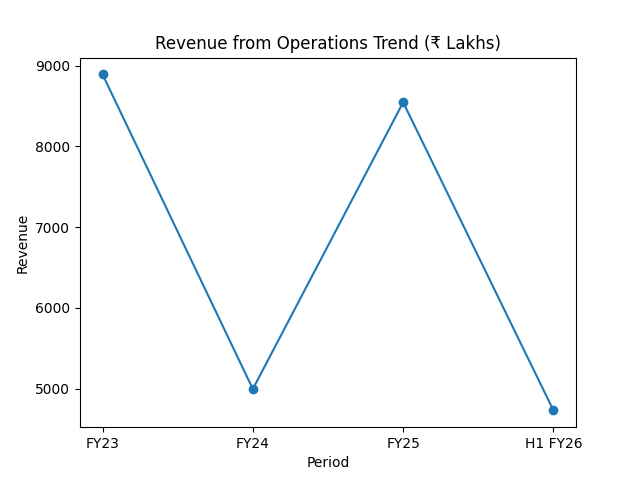
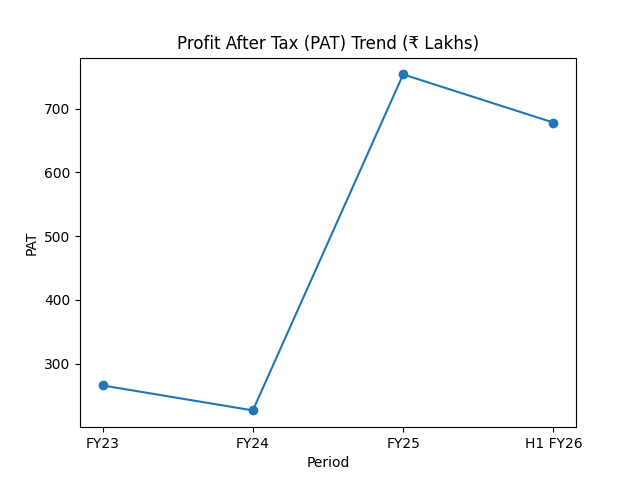
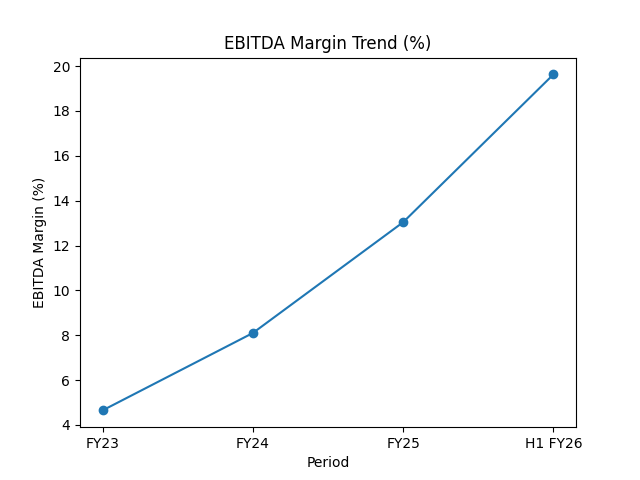
Fractal Industries Limited has demonstrated strong growth and sharp improvement in profitability, particularly in FY25 and H1 FY26. The company transitioned from a low-margin phase to a high-margin operating profile, driven by scale efficiencies and better cost control.
(₹ in lakhs)
Particulars | H1 FY26* | FY25 | FY24 | FY23 |
|---|---|---|---|---|
Revenue from Operations | 4,729.73 | 8,544.87 | 4,994.40 | 8,891.11 |
Total Income | 4,733.40 | 8,551.29 | 5,000.85 | 8,891.11 |
EBITDA | 929.15 | 1,114.81 | 405.23 | 413.12 |
EBITDA Margin (%) | 19.63% | 13.04% | 8.10% | 4.65% |
Profit After Tax (PAT) | 678.17 | 753.76 | 226.68 | 265.83 |
PAT Margin (%) | 14.34% | 8.82% | 4.54% | 2.99% |
*H1 FY26 refers to period ended 30 September 2025
Margins have expanded sharply over three years
FY25 marked a step-change in profitability
H1 FY26 margins indicate sustainability of improved performance
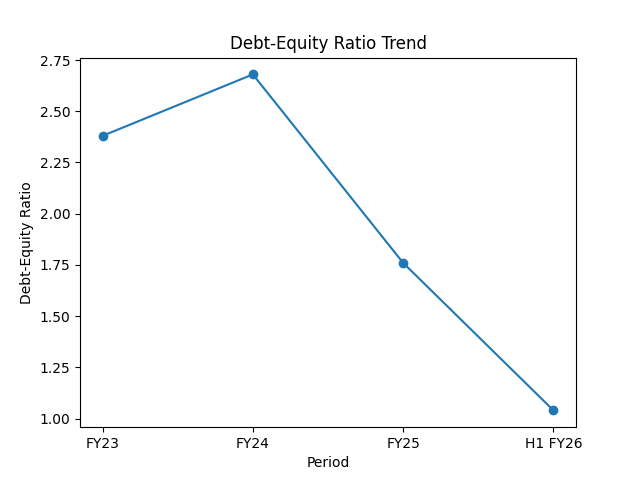
Fractal Industries operates a working-capital-intensive business, which reflects in its borrowing profile. However, leverage has reduced significantly over time.
(₹ in lakhs)
Particulars | H1 FY26 | FY25 | FY24 | FY23 |
|---|---|---|---|---|
Long-term Borrowings | 817.61 | 900.95 | 972.82 | 403.05 |
Short-term Borrowings | 1,644.97 | 1,859.98 | 1,215.22 | 1,001.87 |
Total Borrowings | 2,462.58 | 2,760.93 | 2,188.04 | 1,404.92 |
Debt–Equity Ratio | 1.04x | 1.76x | 2.68x | 2.38x |
Debt-equity reduced from 2.68x (FY24) to 1.04x (H1 FY26)
Indicates improving balance sheet strength
IPO proceeds are expected to further ease working capital pressure
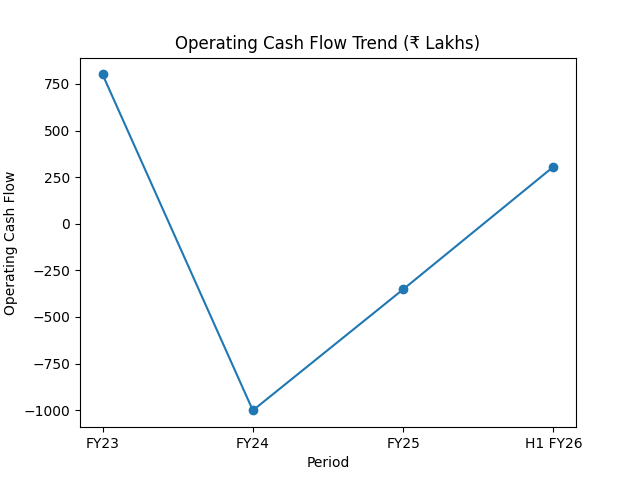
While the company is profitable, cash flows have been volatile, mainly due to inventory and receivables movement — common in manufacturing and supply-chain-linked businesses.
(₹ in lakhs)
Particulars | H1 FY26 | FY25 | FY24 | FY23 |
|---|---|---|---|---|
Operating Cash Flow (OCF) | 306.09 | (351.93) | (1,001.43) | 801.44 |
Investing Cash Flow | (12.43) | (43.18) | (485.86) | (288.30) |
Financing Cash Flow | (284.65) | 393.48 | 686.45 | 293.48 |
Net Change in Cash | 9.01 | (1.63) | (800.84) | 806.62 |
Closing Cash Balance | 14.48 | 5.48 | 7.11 | 807.95 |
Negative OCF in FY24 & FY25 due to working capital expansion
H1 FY26 shows positive operating cash flow
Cash flows expected to stabilize post-IPO
Fractal Industries shows strong improvement in profitability and returns, supported by operating leverage.
Ratio | H1 FY26 | FY25 | FY24 | FY23 |
|---|---|---|---|---|
EBITDA Margin | 19.63% | 13.04% | 8.10% | 4.65% |
Net Profit Margin | 14.34% | 8.82% | 4.54% | 2.99% |
Return on Equity (ROE) | 34.52% | 63.20% | 32.27% | 58.18% |
Return on Capital Employed (ROCE) | 18.99% | 25.07% | 12.33% | 19.14% |
Debt–Equity Ratio | 1.04x | 1.76x | 2.68x | 2.38x |
Basic EPS (₹) | 12.15 | 150.75 | 45.34 | 53.17 |
High ROE driven by margin expansion and leverage
Improving ROCE shows better capital efficiency
Declining debt ratios reduce financial risk
The management of Fractal Industries Limited highlights that the recent improvement in financial performance is the result of:
Better capacity utilization
Focus on higher-margin orders
Tighter control over operating and finance costs
Rationalisation of customer mix
Continue scaling operations without aggressive capex
Improve working capital efficiency
Strengthen balance sheet post-IPO
Maintain margin discipline
Investor takeaway:
Management is prioritizing profitability-first growth, which is critical for SME IPO sustainability.
The IPO is a 100% fresh issue, meaning all proceeds go to the company.
Objective | Description |
|---|---|
Working Capital | Funding day-to-day operational requirements |
General Corporate Purposes | Business expansion, admin, contingencies |
Issue Expenses | IPO-related costs |
Why this matters:
No promoter exit → strong confidence signal.
The issue price is determined through the book-building process, considering:
Earnings growth
Net worth
Return ratios
Comparable SME peers
Metric | Observation |
|---|---|
EPS | Strong improvement in FY25 & H1 FY26 |
ROE | High, driven by margin expansion |
Debt Profile | Rapid deleveraging trend |
Peer Comparison | Valuation aligned with SME manufacturing peers |
Investor note:
Valuation reflects growth-stage SME pricing, not mature large-cap multiples.
Particulars | Pre-Issue | Post-Issue |
|---|---|---|
Equity Shares | 55,80,267 | 78,48,867 |
Paid-up Capital (₹ lakhs) | 558.03 | 784.89 |
Category | Approx. Holding (%) |
|---|---|
Promoters & Promoter Group | ~71% |
Public Shareholders | ~29% |
Lock-in:
Promoter shares are subject to SEBI-mandated lock-in, aligning interests with investors.
The company has not declared dividends in the last three years.
Focus on reinvestment during growth phase
Dividend decisions will depend on:
Cash flows
Capex needs
Financial condition
This is a growth stock, not a dividend yield play (for now).
Holding Period | Tax Treatment |
|---|---|
< 12 months | Short-Term Capital Gains (STCG) |
> 12 months | Long-Term Capital Gains (LTCG) |
Taxes depend on:
Investor category
Holding period
Applicable tax laws at the time of sale
The company has disclosed related party transactions, primarily involving:
Group entities
Promoter-linked parties
Transactions are at arm’s length
No material adverse impact identified
Fully disclosed in financial statements
Agreement | Purpose |
|---|---|
Merchant Banker Agreement | IPO management |
Registrar Agreement | Share allotment & records |
Market Making Agreement | Post-listing liquidity |
Underwriting Agreement | Issue support |
Particular | Details |
|---|---|
Issue Type | 100% Fresh Issue |
Face Value | ₹10 per share |
Exchange | BSE SME |
Market Maker Portion | Included |
Category | Allocation |
|---|---|
QIBs | Up to 50% |
NIIs | Minimum 15% |
Retail / Individual | Minimum 35% |
Equity shareholders are entitled to:
Voting rights
Dividend rights (if declared)
Participation in corporate actions
Share in surplus on liquidation
Rights are proportional to shareholding.
The company confirms compliance with:
Companies Act, 2013
SEBI ICDR Regulations
SME Listing Regulations
No material omissions or misleading disclosures reported as per RHP.